How Much Horsepower Do You Need for a Post-Hole Digger?
By Roy Messiah · Last updated: 19 July 2026
Top pick tractors in this guide
The bottom line
Post-hole diggers need adequate rear PTO torque and hitch stability for auger diameter and soil — not maximum engine horsepower alone. Manufacturer charts list recommended tractor class and auger sizes. Rocky or deep holes push requirements up; sandy fence lines allow smaller pairings on compact frames.
Numeric specs in pick tables come from manufacturer pages in our verified database — not from AI-generated text.
Top picks
Pick 1
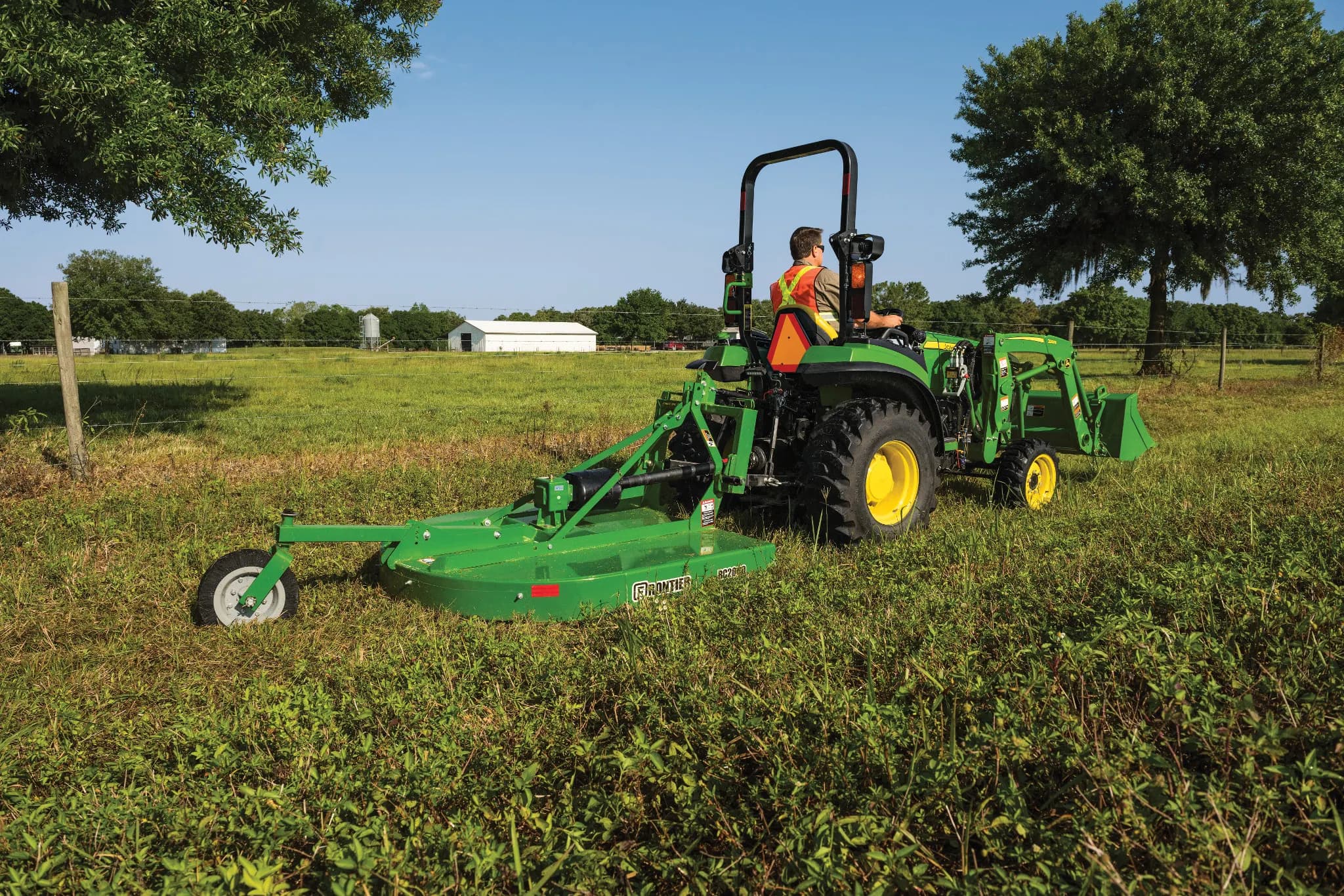
John Deere 2032R
Compact
Compact reference for mid-size augers on typical fence and deck posts — stable hitch for digger vibration loads.
Verified specifications for John Deere 2032R Engine horsepower 31.2 HP Operating weight 2,879 lbs Rear hitch lift @ 24″ 1,356 lbs @ 24″ 
Pick 2
Kubota L3302
Compact
Compact example for comparing PTO and hydraulic down-pressure options against regional auger kits.
Verified specifications for Kubota L3302 Engine horsepower 33 HP Operating weight 2,833 lbs Rear hitch lift @ 24″ 1,435 lbs @ 24″ 
Pick 3
Kioti CK2620
Compact
Compact baseline for smaller augers when soil stays cooperative and posts are modest diameter — verify auger charts against frame mass.
Verified specifications for Kioti CK2620 Engine horsepower 24.5 HP Operating weight 2,634 lbs Rear hitch lift @ 24″ 1,631 lbs @ 24″
How size classes compare
Tractor size classes (typical range)
Sub-Compact
1–5 acres
Loader and mower
Compact
5–20 acres
Bush hog and tiller
Utility
15+ acres
Hay and heavy implements
Illustrative: match class to property size and implement load, not horsepower alone.
Auger diameter drives the pairing
Wider augers cut more soil and load PTO harder. Read the auger OEM chart for minimum tractor class and recommended PTO speed. Our fencing guide covers property workflow; this guide focuses on rating discipline.
Hydraulic down pressure and rocky soil
Some diggers use hydraulic down force beyond PTO spin. Verify pump flow and remotes on the tractor sheet before assuming a three-point mount alone suffices in rock.
Rear ballast and stability
Diggers kick reaction torque into the hitch. Ballast and proper top-link setup reduce front lift on lighter tractors — especially sub-compacts running at the top of auger range.
PTO HP, not engine HP
Digger manuals list minimum PTO horsepower at the shaft. Our profiles store engine HP as a Fact; PTO overlays appear only when verified. Missing PTO shows as Partial — look it up before you buy.
Lift and hitch still matter
A digger that meets PTO can still fail hitch class or rear lift. Run the Attachment Fit checker, then read the digger and tractor OEM pages for your serial year.
FAQ
- Can sub-compact run a post-hole digger?
- Yes with small augers and good soil. Rocky deep holes usually want heavier compact frames and larger auger kits sized together.
- Is PTO or hydraulics the limiter?
- Both can be — depends on digger design. Read the implement manual for PTO requirements and any hydraulic down-pressure needs.
- How does digging differ from bush hog PTO load?
- Diggers load intermittently with shock; cutters load steadily. Hitch strength and frame mass matter more for diggers; see bush hog guide for rotary cutting math.
- What if Fit says Partial on PTO?
- Find the PTO number on the manufacturer sheet for your transmission, then re-check. We will not invent the shaft rating.